 |
 12-09-2007, 10:38 PM
|
#1
|
|
Ensign
Join Date: Dec 2007
Posts: 9
|
 New Owner of 1996 1900 SR Here, Any Advice Welcomed
Hi everyone,
I just took possession of a 1996 Maxum SR. It has the 5.7 liter Mercruiser inboard with, I think, an alpha 1 outboard.
I am completely new to boating, but I had a recent "life changing" experience and wanted a new hobby, so I somehow ended up with this used boat (a story in itself) but I had to shell out money to hook up a tow package to the Jeep and just brought it home.
I am not even sure if this boat is going to run well. I could not start it. The battery could be dead or just disconnected. The engine looks to be in good condition, so does the entire boat actually. It needs a new propeller becase the one it has on it has chipped about an inch on 2 blades of the blades, but I will hold off on that (reading here I learned I might want a 14 1/4 - 19) until I get the motor and electric systems seaworthy.
Its very hard to know where to start with a used, unkown boat. I mean, I don't even know where to start looking for problems. I'm afraid to take it to the authorized dealer, for fear he'll find $1000's of dollars in repair work. 
But, that might just be the best solution. The hull looks in good shape and the engine looks good from what I can tell - hoses and belts are still good, no obvious rust on the clamps or screws etc but it just got delivered and I haven't had much time to look it over. I know I will want at least a complete tune up, which I would do myself if it wasn't so unknown to me. I can only do minor repair work/tuneup to an engine - but with an inboard, and outboard, electrical system, axels, propeller and not even a manual maybe the best thing to do would be to let the dealer do the first workover on it - or at least a thorough inspection and a quote.
Wish me luck. I really do want to start boating! Yes, I know, it's December but I live in Southern California! It might be 75 on Christmas day!
Wish me luck!
|

|

|
|
12-09-2007, 10:43 PM
|
#2
|
|
Ensign
Join Date: Dec 2007
Posts: 9
|
Things I need
Oh, and here are some of things that are obviously missing that I will need:
VHF radio (at least 1, maybe 1 hardwired & 1 portable)
Better life jackets (it came with 7 but they are the cheapo type)
Dog life jacket (labrador, swims great but still too much to ask of him to swim to shore)
iPod/Satellite Stereo system (for boat guests mainly)
So, as someone said:
B-break
O-out
A-another
T-thousand
Anyone advice will be welcomed by the veterans of boating.
__________________
|
|
|
|
|
12-09-2007, 11:23 PM
|
#3
|
|
Admiral
Join Date: Nov 2005
Location: Everett Wa
Posts: 4,681
|
welcome to the zoo there MS...first off...congrats on the new/used boat...second..I'll give you some of my thoughts...
first off
what kind of boating your trying to do...second ..where are you located...cuz that will also tell me alot of what kind of boating your going to partake!..
check the connections and water level on the batt's...clean those first...
look for the batt's switch...should be a big red round knob type switch..turn that to number one batt....you should have muffs going to the outdrive connected to a hose...don't start the boat without water going to the drive..that would be to those 5-6 holes on both sides of the drive just up and fwd of the prop....next don't stick it in gear until you get the prop fixed..take it off and have a prop shop locally fix it...they will do a great job for about 60 bucks....
next...pull the plugs out and do a compression check....all cylinders should be about 140-175 psi....next replace the plugs and distr. cap/rotor with a new one....drain all the oils out of the engine and drive...make sure you have a manual for the boat...there are 2 plugs on the left side lower half of the drive....when you replace the oil..use mercruiser outdrive oil and get a pump..pump it from the bottom ......when you see oil coming out the top hole...plug it and give it about 4-5 more shots......
I don't know if you have a transome plug that is attached to a hose that goes to the engine used for draining the oil...if not...then our going to need an oil bouy to suck it out of the dipstick tube.....now you can warm the engine oil up on the trailer ...don't rev above 1400 rpm while on the trailer with water going from a hose...replace all gas filters...don't know if you have 1 or 2...either way..replace them
the next thing to find out is when was the last time the impeller was changed...if it hasn't in a few yrs..now's the time to do it....it is in the lower half of the outdrive...there are 6 bolts holding the upper to the lower....put the boat in gear..engine off....pull the 6 bolts....gently wiggle the drive and pull it at the same time...do this when you have drained the oil out of the drive....get the instruction book cuz it's really easy to replace the impeller but you want to make sure the blades are turning in the same direction that you pulled it out.......after you reassemble the lower drive with the upper drive..use the main 4 bolts to sinch the drive up to the upper drive.....now fill with oil with instructions above......
replace all the zinc;s on the outdrive...keep up with those cuz they will save you lots on a drive repair....
now your ready to start the engine......here's the trick.....boats don't have automatic chokes....so..you have to pump it in neutral 3 times...first pump sets the choke..second starts priming....third pumps gas into the throat of the carb...set the throttle to about 1/3 setting and now hit the starter....don't let it over rev until it the temps get up to normal.........
that should be about it..when you get it out on the water...you can check it for wide open throttle....you should get about 4400-4800rpm at full throttle....that should put you about 40-42 mph.......depending on the model of boat you have......and in smooth water......if your not getting WOT then check the timing..should go to something like 30degs btc at 3k rpm.....
the other thing I thought of is while on the trailer..you should take a small plastic type hammer...kinda like a yellow type of mallet....walk around the hull of the boat and tap on the hull listening to the hull...should sound nice and solid...if you get a thump..that's a place that might need some work on the fiberglass cuz there might be some water absorbtion..........
hope this helps......let us know what all happens.... 
__________________
Don't compare your life to others. You have no idea what their journey is all about. 
------------------------
SSN683 Association member 
Par Excellence
------------------------------
2008 Bayliner 340 - "Wild Whim"
--------------------------------------
I live in my own little world....but it's okay-they know me here!!! 
Avid practitioner of the martial art: KLIK-PAO. 
Tap-Rack-Bang
Anyone that sez "Size doesn't matter" has never owned a boat!
|
|
|
|
|
12-10-2007, 12:07 AM
|
#4
|
|
Ensign
Join Date: Dec 2007
Posts: 9
|
Thanks
Thanks for your welcome and reply.
I live in Los Angeles, and the boat is up near Castaic lake in a warehouse where I work.
Eventually I expect to put her at sea down at Marina Del Rey, but at first, once I know she actually runs I will start off this spring in some of the local lakes - Castaic, Piru, Diamond and possibly Isabella though that's about a 4 hour trek.
Back about 20 years ago I did some water skiing but that's not what I want to do now. But the boat did come with a monster tower and I know some of my friends will want to ski but mainly I just want to go out and fish and listen to the sounds of the water. That's why I'd like to take her out off the coast.
I know not to run it without a waterhose connected - I wondered if it was worthwhile to install a watercooler/("radiator") because, the boat being about 10 years old I don't know how long it would last with seawater cooling it. But thanks for the tip about where to run the hose when I do decide to start 'er up. I know it wouldn't start because not even the electric would turn on. The battery is either dead or, hopefully, just not connected or switched off. I really didn't get a good look at it and now it's dark.
Mostly though, I took this used boat because I wanted to see if I would enjoy boating enough to eventually buy a newer, possibly bigger one. I don't really want to dump a fortune in repairs but I do want it to run at least 6 months, to see if this is something I would enjoy doing.
Thanks again for any tips, and for the ones you already gave!
|
|
|
|
|
12-10-2007, 01:19 AM
|
#5
|
|
Admiral
Join Date: Nov 2005
Location: Everett Wa
Posts: 4,681
|
in that case...I wouldn't go to the expense of adding fresh water cooling to your boat...for the few times you'll go to the ocean...just flush the outdrive and engine with salt away!!...get it from west marine and then flush with freshwater for atleast 15 min. at idle........
welcome to the zoo!!..now ..final bit of advice is to take an approved boat safety course...also make sure your boat has atleast 2 fire extinquishers and appropriate safety gear....first aid kit....radio..with mnssn number and gps hooked up to the vhf....also..if the boat doesn't have it..get a good gps...I have 2..one built in and one hand held......I also have 2 vhf radios...and if your going to go off shore...don't forget to file a boating plan....and have a few spares and tools to do maybe minor repairs..like belts and fuses...etc.....
Best of luck with the new boat and enjoy!!...
__________________
Don't compare your life to others. You have no idea what their journey is all about.
------------------------
SSN683 Association member
Par Excellence
------------------------------
2008 Bayliner 340 - "Wild Whim"
--------------------------------------
I live in my own little world....but it's okay-they know me here!!!
Avid practitioner of the martial art: KLIK-PAO.
Tap-Rack-Bang
Anyone that sez "Size doesn't matter" has never owned a boat!
|
|
|
|
|
12-17-2007, 12:50 AM
|
#6
|
|
Ensign
Join Date: Dec 2007
Posts: 9
|
Update
Hi all,
I took her in to the local Maxum dealer for a thorough inspection. I was pleased to hear their report. Almost everything is in very good condition.
We're going to do a "tune up" as it were, change all the fluids and filters, new spark plugs, new impeller etc. It will get some new seals here and there. We're going to put a new fuel pump on it, and a new propeller. I'll go with the dealer recommendation on the prop.
I get about 12 days off between Christmas and New Years so I hope to take 'er out in one of the local lakes real soon!
Now I have a question - which specs should I look for in a VHF radio? I'll search around for the answer.
|
|
|
|
|
12-17-2007, 04:00 AM
|
#7
|
|
Commander
Join Date: Feb 2007
Location: PA
Posts: 334
|
Congratulations and welcome to the wonderful world of boat ownership.
As for VHF radios, they will all be the same power and have the same channels. They should all have Digital Selective Calling (DSC). The differences will be in the features. Things like the size of and information shown on the display. The ability to use a second microphone and enhanced DSC capabilities when connected to a GPS, will determine the price. The antenna will have a profound effect on performance (this is where handhelds fall short). The standard is an a 8 foot fiberglass mounted as high as possible. I use a 3 foot steel antenna and it works ok on small lakes.
You might want to add a GPS unit to your list of things to buy. Even a small portable chartplotter with NEMA0183 capabilities will add to your safety and enjoyment.
__________________
"Democracy is two wolves and a lamb voting on what to have for lunch. Liberty is a well-armed lamb contesting the vote."
MMSI# 338052622
|
|
|
|
|
12-17-2007, 04:01 AM
|
#8
|
|
Admiral
Join Date: Nov 2005
Location: Everett Wa
Posts: 4,681
|
MS...for this size boat...are you planning on putting in a gps??..cuz what you want to have is the gps and the vhf connected with the mssn number...that connection is what tells search and rescue where exactly you are.......so...make sure it's an mssn compatable radio....
if your not getting a gps...then atleast get one that has the capability to hook it up later..the number is free to get from Boat US and still load it into the radio...that will atleast keep your info ready for the SAR team to know who should be on the boat...
Congrats and thanks for posting back to us and letting us know how it went....
__________________
Don't compare your life to others. You have no idea what their journey is all about.
------------------------
SSN683 Association member
Par Excellence
------------------------------
2008 Bayliner 340 - "Wild Whim"
--------------------------------------
I live in my own little world....but it's okay-they know me here!!!
Avid practitioner of the martial art: KLIK-PAO.
Tap-Rack-Bang
Anyone that sez "Size doesn't matter" has never owned a boat!
|
|
|
|
|
12-17-2007, 07:18 AM
|
#9
|
|
Ensign
Join Date: Dec 2007
Posts: 9
|
Expensive Stuff
I watched a powerpoint presentation at boatus.com about vhf & dsc radios. I looked around online for GPS systems and MSSN numbers. But I could find nothing that would help me make a decision based on my possible needs. I simply have no idea what would be the right setup for me.
I saw this unit, the "Standard Horizon CPV350 GPS/VHF Radio" at this location (not that I endorse the store I just saw the unit there via google search)
http://www.lakepowelldiscountmarinee...thocpgpra.html
That unit seems to have it "all in one" and I'm not sure if that's a good thing or not. It seems expensive and I could get separate VHF and GPS units for less but I honestly cannot find reliable source that explains what I might need.
It's possible I could be 10 miles off the coast - say 20 miles just for arguments sake. I appreciate the need for a good antenna, but does that count for the GPS unit too?
Some friends want me to buy a fishfinder so I gotta consider adding that as well. Another $1000? I'll spend what i need to to be safe but I sure don't want to overbuy for my needs.
I figure I will need a handheld submersible as a backup radio as well.
It's all new to me and I've been trying to read as much as I can, I just can't possibly know what I absolutely need to have, and what is too much for my vessel.
Once again any and all advice would be appreciated on the kinds of VHF and GPS I might need in these situations. Thanks in advance.
|
|
|
|
|
12-17-2007, 03:20 PM
|
#10
|
|
Admiral
Join Date: Nov 2005
Location: Everett Wa
Posts: 4,681
|
well..20 mi. off shore is a lot of water to try and find you if you end up in trouble....be aware that a hand held vhf is only 5 watts..not alot of horse power in that if your 20 miles out....second...again..that's alot of water to try and find you..so...you can get a good raymarine gps..even a garmen is pretty good.......tie it to any decent radio for about 150 bucks and that would do you quite well.....i'd look in that direction...
the MSSN number can be had at Boat US....it's really easy to get...just fill in the form and bada bing...done..then input into the radio....done!!..
__________________
Don't compare your life to others. You have no idea what their journey is all about.
------------------------
SSN683 Association member
Par Excellence
------------------------------
2008 Bayliner 340 - "Wild Whim"
--------------------------------------
I live in my own little world....but it's okay-they know me here!!!
Avid practitioner of the martial art: KLIK-PAO.
Tap-Rack-Bang
Anyone that sez "Size doesn't matter" has never owned a boat!
|
|
|
|
|
12-17-2007, 05:02 PM
|
#11
|
|
Commander
Join Date: Feb 2007
Location: PA
Posts: 334
|
The all in one units seem great from a compatibility standpoint and you can't beat the ease of installation but, they are very expensive.
This is my setup.
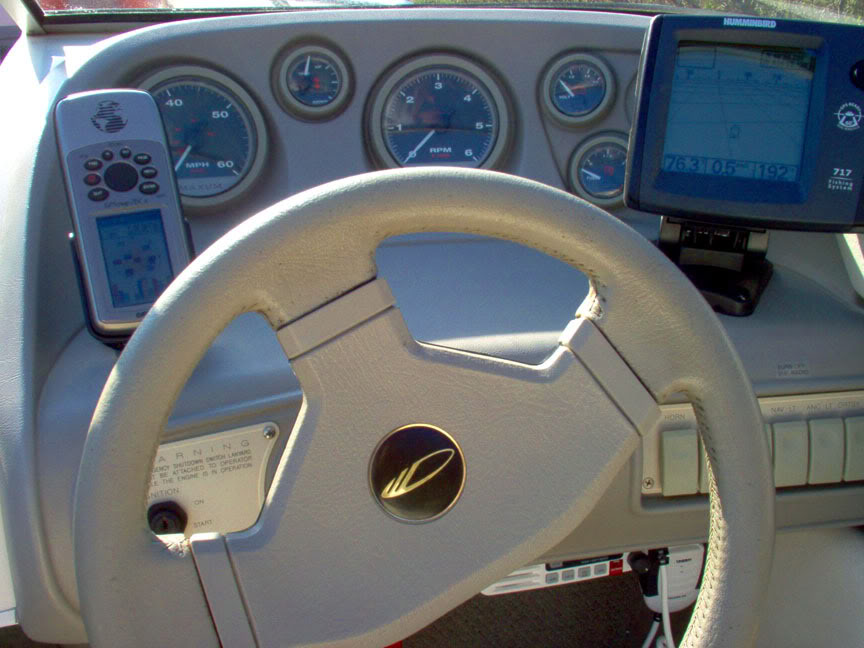
I use the same handheld GPS unit on the boat in the car and hiking/geocaching. The radio, fishfinder and GPS are all connected. This way I can use the GPS for the DSC features on the radio and veiw GPS information on the larger screen of the fish finder.
I think everything together cost me about $650.
Quote:
|
I appreciate the need for a good antenna, but does that count for the GPS unit too?
|
My portable GPS has a built in antenna that works fine. If you get a fixed mount type you will need a separate antenna for that. They are shaped like a large mushroom. Mounting height is not an issue because the satellites are above the horizon.
I use my fishfinder not for finding fish so much. I use it so I know the depth of the water and the contour of the bottom.
I only ever boat in small lakes and am never more than 2 miles from shoreline. So you may want something better then what I have.
__________________
"Democracy is two wolves and a lamb voting on what to have for lunch. Liberty is a well-armed lamb contesting the vote."
MMSI# 338052622
|
|
|
|
|
12-18-2007, 06:32 AM
|
#12
|
|
Ensign
Join Date: Dec 2007
Posts: 9
|
Thanks
Thanks for the pic of your setup. I did see the handheld GPS units and that they can be connected to the VHF.
Question for you - you don't find that the VHF bangs up against your knees or shins the way you have it setup? I haven't spent a whole lot of time in the captain's chair but I didn't notice a whole lot of legroom on my 19'. So if I got the all in one I figured I'd mount it up on the dash.
What I cannot seem to figure out, though, is what is good enough for my "worst case" contingency. The lakes around here are small enough that I'd eventually drift and hit land - and most of them have developments close enough that I could see the lights of nearby homes. That is why I asked about the 20 mile example. Like if I pass out and wake up adrift at sea. How much is reasonably enough? I can't seem to find a way to figure it out, e.g. there is no way that I know of to gauge how many miles or NM any particular unit can transmit.
I did notice the mushroom antenna, so I guess I would need to install that as well as a VHF antenna. But having the depth indicator (fishfinder), VHF and GPS in one is a compelling option. I'm leaning towards spending the extra bucks and buying that "all in one" unit, but I am going to ask around for confirmation that it will be right for my 'worst case' scenario.
Thanks for your help and insight.
|
|
|
|
|
12-18-2007, 02:09 PM
|
#13
|
|
Commander
Join Date: Feb 2007
Location: PA
Posts: 334
|
You can't see it in my picture, but there is a narrow shelf under the helm area that the radio is just above. I also normally just rest one knee on the captains chair while I pilot the boat. This way I am above the windshield and have an unobstructed view of the water ahead.
All fixed mount radios transmit 25watts on their highest setting. So in that regard they are all equal. The number one factor affecting VHF transmitting distance is antenna height. There are no guarantees as to how far the signal will travel.
VHF electromagnetic propagation is known as Line-of-Sight (LOS). Like a flashlight, it can only transmit in straight lines. This differs from lower-frequency radios in the HF range, such as HF-SSB or Citizen’s Band (CB) radio that can rely on "skip" to transmit long distances. For this reason, the transmission range for VHF marine radios is effectively limited by the curvature of the earth and antenna height. In this regard, the higher you can mount your antenna on your boat, the further you will be able to communicate. Of course, this is simply because the line-of-sight for the higher antenna is greater. There is a mathematical formula that can help in determining the line-of-sight distance:

To estimate the communications distance, you must perform this calculation for both the transmitting and receiving boat. Generally you would make the measurement from the top of the antenna to the waterline.
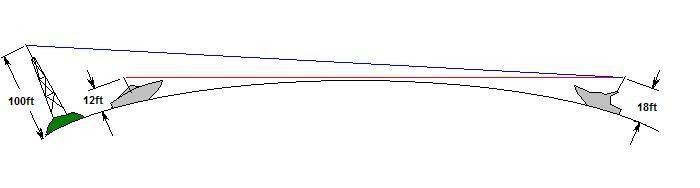
In the above scenario, we can determine the likely communication distances between the two boats, as well as the distant boat and the tower.
The boat with the 12ft antenna, the distance to horizon is approx. 4.2 miles.
The boat with the 18ft antenna, the distance to horizon is approx. 5 miles.
The antenna on the tower, the distance to horizon is approx. 12 miles.
The maximum theoretical distance that the two boats can communicate is 9.2 miles (4.2mi + 5mi)
The maximum theoretical distance the distant boat can communicate with the tower is 17 miles (12mi + 5mi)
It must be noted that this is a theoretical distance due to the line-of-sight limitation. The gain of the antennas will not increase this distance; however, they will make a marginal signal stronger - within the limitation of the line-of-sight distance. In reality, envionmental conditions, such as islands that obstruct the line-of-sight path, weather conditions such as rain or fog, or atmospheric ducting all affect the distance the signal travels.
OK, so you have been on the East side of Lake Michigan, and have heard the USCG from the other side of the lake - more than 80 miles, what gives? There is weather phenomena such as atmospheric ducting that act like a conduit for longer distance communications, but this is not reliable, since it relies on changing weather conditions. And, it is not likely that even though you may hear the transmission, you will be able to engage in a 2-way communication.
(Special thanks to AL C. from BoatingABC for educating the boating world)
__________________
"Democracy is two wolves and a lamb voting on what to have for lunch. Liberty is a well-armed lamb contesting the vote."
MMSI# 338052622
|
|
|
|
|
12-20-2007, 05:43 AM
|
#14
|
|
Ensign
Join Date: Dec 2007
Posts: 9
|
Wow, Excellent
Wow! Thanks. That answers my question perfectly. Now I understand what is important and why the he handhelds may not be so great (they are only 6 feet off the ground!).
Thanks so much.
__________________
|
|
|
|
|
 Posting Rules
|
You may not post new threads
You may not post replies
You may not post attachments
You may not edit your posts
HTML code is Off
|
|
|
|
 » Recent Threads
 |
|
|
|
|
|
|
|
|
|
|
|
|
|
|
|
|
|
|
|
|
|






 Linear Mode

